Gold Investing · Gold Coins · Investor Education · 8 MIN READ
Can You Buy Gold Directly From the U.S. Mint? Bullion vs. Collectible Coins Explained
You cannot buy ordinary U.S. Mint bullion coins directly from the Mint. Learn how Authorized Purchasers work, what the Mint sells directly and how to compare dealer premiums.
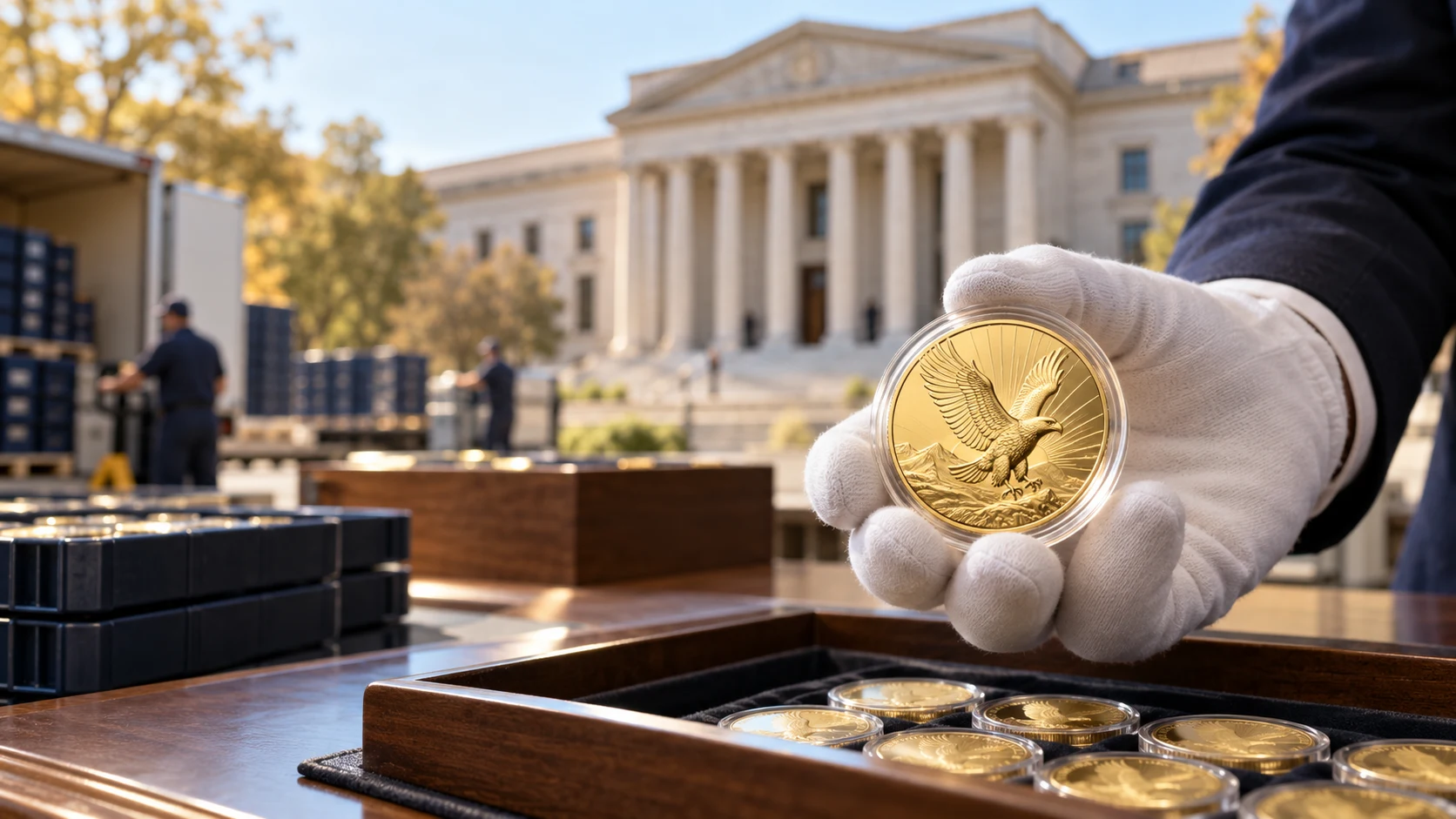
No—an individual investor cannot buy American Eagle or American Buffalo bullion coins directly from the U.S. Mint. The Mint distributes bullion through a network of Authorized Purchasers, which supply wholesalers, financial institutions and retail dealers. The Mint does sell certain proof and uncirculated collectible coins directly to consumers, but those are different products with different pricing.
That distinction matters when you compare offers. A government-minted coin is not automatically a direct government purchase, and the premium charged by the Mint to a primary distributor is not the final retail premium a buyer will pay.
The short answer: bullion goes through distributors
The U.S. Mint defines a bullion coin as an investment-grade coin valued primarily by the weight and fineness of its precious metal. Its bullion page says American Eagle gold bullion coins come in one-ounce, half-ounce, quarter-ounce and tenth-ounce sizes, while the American Buffalo gold bullion coin is available in a one-ounce size.
The Mint does not sell those bullion coins to the public. Instead, it sells them to approved firms called Authorized Purchasers. Those firms then support a two-way market by distributing coins through the wholesale and retail chain and buying coins back into the market.
In practical terms, a typical route looks like this:
U.S. Mint → Authorized Purchaser → wholesaler or retail dealer → individual buyer
The chain can be shorter when an Authorized Purchaser also sells to consumers, but the Mint warns that not every Authorized Purchaser does. Its published list is not a blanket government endorsement or guarantee of any company's services.
Why doesn't the Mint sell bullion directly?
The Mint says its Authorized Purchaser system is designed to distribute large quantities efficiently and maintain broad availability in both retail and major investment markets. Authorized Purchasers must meet financial and professional requirements and place large minimum orders.
As of October 21, 2026, the Mint's current Authorized Purchaser page lists a minimum gold bullion order of 1,000 ounces. It also says the Mint charges Authorized Purchasers the LBMA PM gold price plus the following premiums for American Eagle gold bullion coins:
- One ounce: 3%
- One-half ounce: 5%
- One-quarter ounce: 7%
- One-tenth ounce: 9%
These are Mint-to-Authorized-Purchaser terms, not guaranteed consumer prices. The Mint reserves the right to change its premium structure. Downstream wholesalers and dealers add their own costs and margins, and retail premiums can vary with product size, supply, demand, payment method and order quantity.
The official schedule also illustrates a common bullion pattern: smaller fractional coins usually carry a higher percentage premium than a one-ounce coin. They require less cash per purchase, but an investor receives less gold for each dollar spent when all else is equal.
What can you buy directly from the U.S. Mint?
The U.S. Mint sells certain proof and uncirculated numismatic products directly through its store. A proof coin is made using a specialized process that produces detailed, frosted design elements over a mirror-like field. The Mint states that its proof and uncirculated coins are offered at fixed prices and include Certificates of Authenticity.
That does not make a proof coin interchangeable with a bullion coin. A bullion coin is purchased mainly for its precious-metal exposure. A collectible coin may also be priced for finish, packaging, mintage, demand and collector appeal.
For example, two coins can contain the same stated amount of gold but sell at very different premiums. A buyer whose goal is metal exposure should compare the total acquisition cost with the value of the gold content, rather than assuming a direct Mint listing is the lower-cost investment.
A hypothetical premium comparison
Suppose the spot value of the gold in a one-ounce coin is $3,000. These numbers are purely illustrative and are not current quotes.
Dealer A offers a bullion coin for $3,180. Its premium over metal value is:
($3,180 − $3,000) ÷ $3,000 × 100 = 6%
Dealer B offers a collectible version containing the same amount of gold for $3,750. Its premium over metal value is 25%.
The second coin may have collector value, but gold would have to appreciate much more—or collector demand would have to support the extra premium—before the owner could recover the initial difference. A dealer's future buyback price may also treat the two products differently.
For a fuller break-even method, see https://goldsilver.top/blog/gold-bullion-premiums-break-even-calculation
How to buy U.S. Mint gold bullion more carefully
1. Start with the correct product
Confirm whether the listing is bullion, proof, uncirculated or a separately graded collectible. Do not rely only on words such as “official,” “limited” or “government gold.” Ask for the exact coin, year, weight, metal content and condition.
The legal face value stamped on an American Gold Eagle is also not its normal market value. Its bullion value is driven primarily by gold content and market pricing. Read the distinction here: https://goldsilver.top/blog/gold-eagle-face-value-vs-bullion-value
2. Compare against metal value
Check a current spot reference at https://goldsilver.top/prices, then convert it to the coin's gold weight. Use the CFTC's formula:
(Sales price − spot value of the coin's metal) ÷ spot value × 100 = premium percentage
Be consistent: compare the same product, weight, condition, payment method and delivery terms across sellers. A posted “as low as” price may require a large order or a payment method with fewer fees.
3. Ask for the complete delivered price
The advertised coin price may not be the final cost. Request a written total that includes the product premium, commission, payment fee, shipping, insurance, storage and any applicable tax. FINRA advises buyers to obtain a full accounting of fees and determine how much the metal must rise to break even.
Also ask for the dealer's current buyback bid on the same item. The distance between your delivered purchase price and the dealer's buyback bid is a more useful starting loss measure than the purchase premium alone.
4. Research the seller
The U.S. Mint advises buyers to understand a dealer's reputation and use extra scrutiny when a coin is offered below the current market price. The CFTC and FINRA recommend checking the seller's physical address, operating history, ownership and complaint record.
Retail physical-metal dealers are not uniformly regulated at the federal level. Appearing on the Mint's Authorized Purchaser list means a firm participates in the Mint's primary distribution network; it does not mean the government guarantees every retail transaction. Likewise, a dealer selling genuine U.S. Mint coins does not necessarily have a direct relationship with the Mint.
5. Avoid pressure and financing pitches
FINRA warns against claims that precious metals cannot decline, promises of large profits and artificial urgency. Gold prices fluctuate, and physical ownership adds risks such as theft, loss and storage expense.
The CFTC says buyers should avoid unsolicited cold calls, emails, social-media pitches and infomercials. Leveraged purchases can add interest charges and margin risk. If a seller is financing a transaction and you will not receive the metal promptly, check the firm's registration and obtain independent advice before sending money.
Is a certificate enough to prove authenticity?
No single document should replace product and seller verification. A Mint Certificate of Authenticity normally accompanies certain direct-sale collectible products, while standard bullion may be sold through dealers without the same retail packaging.
For bullion, compare the coin's weight, diameter, design features and metal specifications with the U.S. Mint's published information. Ask what authenticity guarantee and return policy the seller provides. Be cautious of prices that appear materially below metal value because a genuine dealer cannot sustainably sell standard bullion for less than the contained gold is worth.
Frequently asked questions
Can I order a bullion American Gold Eagle on usmint.gov?
No. The Mint does not sell American Eagle bullion coins directly to the public. Consumers normally buy them from coin or precious-metal dealers.
Why does the U.S. Mint website sell some gold coins?
The Mint directly sells certain proof, uncirculated and other collectible products. These are numismatic products, not the same distribution channel as ordinary bullion coins.
Does buying from an Authorized Purchaser guarantee the lowest price?
No. Authorized Purchaser status relates to primary distribution. Retail price, shipping, payment fees and buyback terms still need to be compared. The Mint also notes that not all Authorized Purchasers sell directly to consumers.
Is the Mint's 3% one-ounce Gold Eagle premium the premium I will pay?
Not necessarily. That is the current charge from the Mint to an Authorized Purchaser. A consumer price can include additional wholesale and retail costs, and the Mint may change its schedule.
Are smaller Gold Eagles cheaper?
They require fewer dollars per coin, but they typically cost more per ounce of gold. The Mint's current primary-distributor premiums rise as Gold Eagle size decreases.
Bottom line
You can buy gold coins made by the U.S. Mint, but ordinary bullion reaches individuals through a dealer network rather than a direct Mint checkout. The Mint's online store is mainly the direct route for specific collectible products.
Before buying, identify the product type, calculate its premium over metal value, obtain all costs and buyback terms in writing, verify the seller and avoid pressure or leverage. Government manufacture can verify a coin's stated specifications; it does not eliminate price risk or guarantee that a retail offer is fair.
Sources
United States Mint, Bullion Coins: https://www.usmint.gov/coin-programs/bullion-coins/
United States Mint, Becoming an Authorized Purchaser (premium schedule and minimums, checked October 21, 2026): https://www.usmint.gov/coins-precious-metal-coins/becoming-an-authorized-bullion-purchaser/
United States Mint, Authorized Purchasers: https://www.usmint.gov/coins-precious-metal-coins/bullion-authorized-purchasers/
United States Mint, Collectible and Investment Coins: https://www.usmint.gov/learn/coins-and-medals/collectible-coins
United States Mint, Bullion Consumer Awareness: https://www.usmint.gov/coins-precious-metal-coins/bullion-consumer-awareness/
CFTC and FINRA, 10 Things to Ask Before Buying Physical Gold, Silver, or Other Metals: https://www.cftc.gov/LearnAndProtect/AdvisoriesAndArticles/Metals10Things.html
FINRA, 4 Tips to Know Before Buying Physical Precious Metals, March 24, 2026: https://www.finra.org/investors/insights/physical-precious-metals
CFTC, Compare Premiums and Fees: https://www.cftc.gov/LearnAndProtect/AdvisoriesAndArticles/CustomerAdvisory_COVID19PreciousMetals.htm
This article is educational and does not provide personalized investment, legal or tax advice.