Gold Education · Gold History · 7 MIN READ
Who Owns the Gold at Fort Knox? Treasury vs. the Federal Reserve
The United States owns the gold at Fort Knox. Here is how Treasury ownership, U.S. Mint custody, Federal Reserve gold certificates, and annual controls fit together.
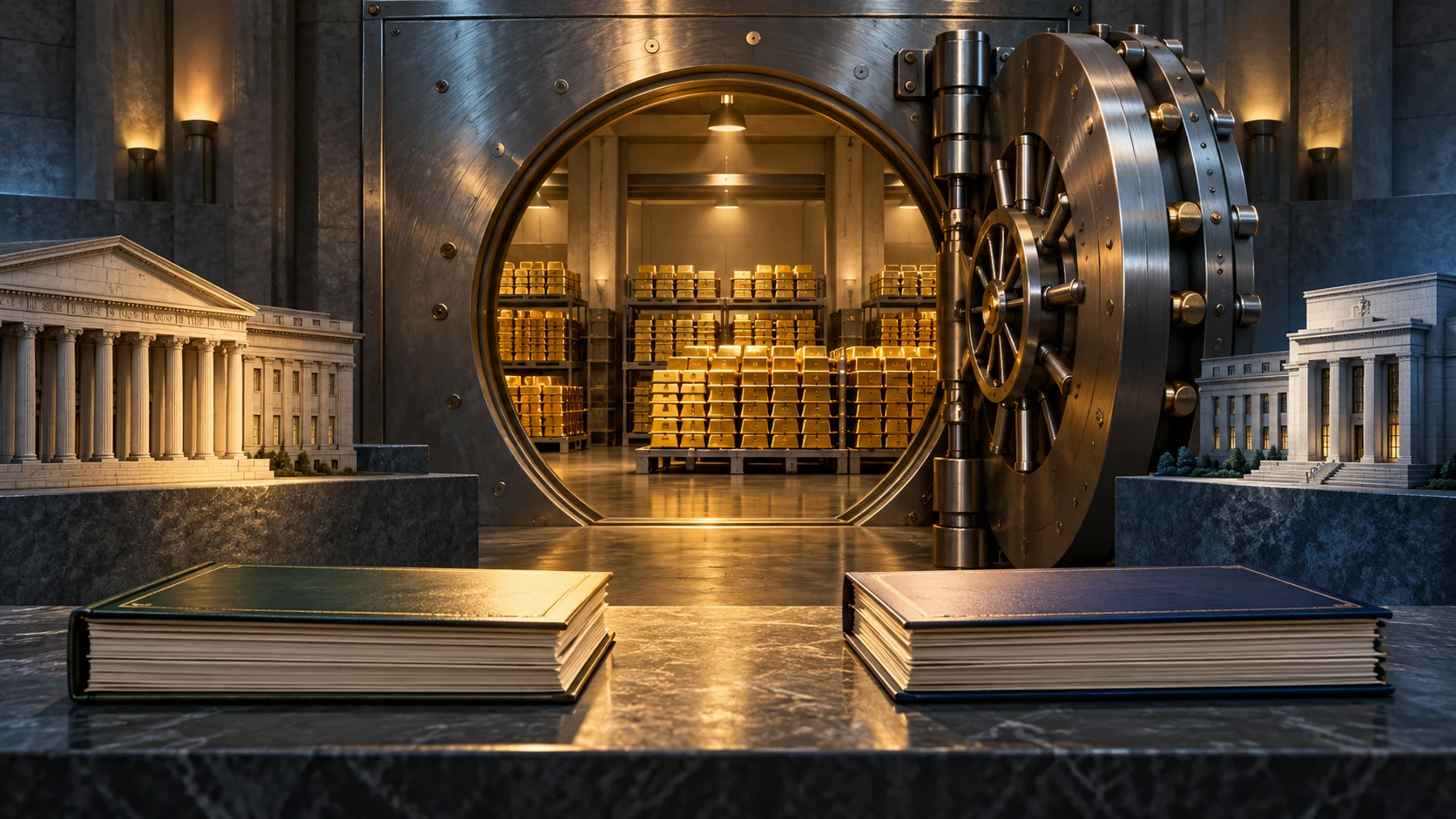
The short answer is the United States owns the gold at Fort Knox. More precisely, it is part of the U.S. government gold reserve administered through the Department of the Treasury. The U.S. Mint safeguards the bullion at the Kentucky depository. The Federal Reserve does not own it.
That sounds simple, but three different ideas—ownership, custody, and accounting—are often blended together. Separating them explains why the Mint operates the vault, why Federal Reserve Banks carry gold certificates, and why some Treasury-owned gold is physically stored at the Federal Reserve Bank of New York.
Who legally owns the Fort Knox gold?
The U.S. government does. The U.S. Mint's official Fort Knox page describes the bullion as an asset of the United States and reports 147.3 million ounces of gold at the depository. The same page says about half of Treasury's stored gold is kept there.
The Federal Reserve's own public guidance is equally direct: the Federal Reserve does not own gold. Under the Gold Reserve Act of 1934, the Federal Reserve Banks transferred title to their monetary gold to the U.S. Treasury.
In ordinary language, people often say “Treasury owns the gold.” That is useful shorthand because Treasury administers and reports the reserve. In formal government reporting, it is described as U.S. government-owned gold.
What is the U.S. Mint's role?
The Mint is the custodian, not a private owner. It is a bureau of the Treasury Department, and it secures deep-storage gold at Fort Knox, West Point, and Denver. “Deep storage” means bullion held in sealed vault compartments rather than working stock used for authorized coin production.
Custody answers “who physically safeguards the asset?” Ownership answers “whose asset is it?” The distinction matters. A warehouse does not become the owner of everything stored inside it, and a custodian cannot treat protected assets as its own inventory.
The Fort Knox figure also should not be confused with the entire U.S. gold reserve. Treasury's published status report lists 261,498,926.241 fine troy ounces in total, including gold held at other Mint facilities and Treasury-owned gold in Federal Reserve Bank custody. The location of a bar does not determine its owner.
For a broader explanation of that principle, see [Why Do Countries Store Gold Abroad? Custody vs. Ownership](/blog/why-countries-store-gold-abroad-custody-ownership).
Why do Federal Reserve Banks have gold certificates?
Gold certificates are the accounting bridge between Treasury's gold and the Federal Reserve Banks. They are not warehouse receipts assigning specific Fort Knox bars to the Fed.
Title 31, Section 5117 of the U.S. Code directs the Treasury Secretary to issue gold certificates against transferred gold and to hold enough Treasury gold as security for the required dollar amount. Treasury's financial reporting says these certificates are payable to the Federal Reserve Banks and valued at the statutory rate of $42.2222 per fine troy ounce.
That creates two related entries: Treasury reports the gold as a government asset and a corresponding certificate liability, while the Federal Reserve Banks report gold certificate accounts as assets. An accounting claim is not the same as ownership of the physical bullion.
At the statutory rate, 147.3 million ounces would have a book value of about $6.22 billion. That figure is an accounting value, not an estimate of what the bullion could sell for in the market. Our separate guide, [Why Are U.S. Gold Reserves Valued at About $42 an Ounce?](/blog/why-us-gold-reserves-valued-42-dollars-book-value), explains the difference.
Is all gold in a Federal Reserve vault owned by the Fed?
No. This is another common source of confusion.
The Federal Reserve Bank of New York says none of the gold in its vault belongs to the New York Fed or the Federal Reserve System. It acts as custodian for account holders that include the U.S. government, foreign governments, central banks, and official international organizations.
Treasury's gold status report separately identifies U.S. government gold in Federal Reserve Bank custody. At the same time, most gold in the New York Fed's famous vault belongs to other official account holders. “Stored at a Federal Reserve Bank” therefore does not mean “owned by the Federal Reserve.”
Can the Mint or the Federal Reserve sell Fort Knox gold?
Not on their own initiative. The Mint's job is custody and protection. The Federal Reserve neither owns the Fort Knox bullion nor controls its physical disposition.
Federal law assigns gold transactions and gold-certificate administration to the Treasury Secretary. Any decision involving the government's reserve would have to follow applicable statutory authority, Treasury controls, and public-sector accounting—not the preferences of a vault manager or a regional Federal Reserve Bank.
This is also why Fort Knox should not be viewed like a bullion fund whose manager buys and sells bars to track a market price. It is a sovereign reserve asset with a different legal and operational purpose.
How is the gold checked?
Treasury describes deep-storage gold as bullion secured in sealed compartments that are examined annually by the Treasury Office of Inspector General. A Government Accountability Office review documented the control system in detail: audited compartments were closed with joint seals, annual procedures checked those seals for compromise, and selected inventories included bar counts, identifying marks, weights, and assays.
The GAO reported in 2011 that Treasury OIG had issued annual audit opinions on the Mint's custodial schedules since the 1990s and that no material differences were found in sampled bar testing described by officials. That historical review should not be mistaken for a new full bar-by-bar assay every year. The ongoing control model relies heavily on verified sealed compartments, financial-statement audits, and custody records.
The Mint also says only very small quantities have been removed during regular audits for purity testing and that no gold has been transferred into or out of the depository for many years.
Why the distinction matters to investors
The Fort Knox story is a useful lesson in reading any gold product or reserve claim. Ask three separate questions:
1. Who legally owns the metal? 2. Who holds it, and where? 3. What accounting claim appears on another institution's balance sheet?
Those answers may point to different entities. A custodian can hold gold without owning it, and an institution can own a certificate or financial claim without owning particular bars. The same framework helps when comparing allocated storage, unallocated metal accounts, physically backed funds, and sovereign reserves.
For more on the policy role of official reserves, read [Why Do Central Banks Hold Gold?](/blog/why-central-banks-hold-gold-investor-lessons).
Frequently asked questions
Does the Federal Reserve own the gold at Fort Knox?
No. The Federal Reserve says it does not own gold. Fort Knox bullion is part of the U.S. government gold reserve administered by Treasury and safeguarded by the U.S. Mint.
How much gold is at Fort Knox?
The U.S. Mint reports 147.3 million ounces. The Mint labels this figure as present holdings; its public page does not provide a live market-price valuation.
Are Federal Reserve gold certificates redeemable for Fort Knox bars?
They should not be treated as claims to specified bars. Treasury holds gold as statutory security for certificates issued to Federal Reserve Banks and may redeem the certificates under federal law, but the certificates are accounting instruments rather than allocated-bar warehouse receipts.
Is Fort Knox the same as the New York Fed gold vault?
No. Fort Knox is a U.S. Mint bullion depository in Kentucky holding U.S. government gold. The New York Fed vault is a custody facility in Manhattan holding gold for the U.S. government and other official account holders; the New York Fed says none of that vault's gold belongs to the Fed itself.
Is the Fort Knox gold valued at market price in government accounts?
No. Treasury uses the statutory rate of $42.2222 per fine troy ounce for the U.S. government gold reserve. That book value is distinct from market value.
Sources and methodology
This article was reviewed on October 22, 2026. It relies on primary government sources and separates physical location, legal ownership, custody, and balance-sheet treatment.
- [U.S. Mint: Fort Knox Bullion Depository](https://www.usmint.gov/about/mint-tours-facilities/fort-knox)
- [Federal Reserve Board: Does the Federal Reserve own or hold gold?](https://www.federalreserve.gov/faqs/does-the-federal-reserve-own-or-hold-gold.htm)
- [U.S. Code, Title 31, Section 5117: Transferring gold and gold certificates](https://uscode.house.gov/view.xhtml?edition=2023&req=granuleid:USC-2023-title31-section5117)
- [Treasury Bureau of the Fiscal Service: Status Report of U.S. Government Gold Reserve](https://fiscal.treasury.gov/reports-statements/gold-report/current.html)
- [U.S. Treasury: Fiscal Year 2025 Agency Financial Report](https://home.treasury.gov/system/files/266/Treasury-FY-2025-AFR.pdf)
- [Federal Reserve Bank of New York: Gold Vault](https://www.newyorkfed.org/aboutthefed/goldvault.html)
- [U.S. Government Accountability Office: Gold Reserve Transparency testimony](https://www.gao.gov/products/gao-11-768t)
This material is educational and does not provide investment, legal, or tax advice.