Gold Education · Gold History · 8 MIN READ
Why Is Gold Measured in Troy Ounces? 31.1035 Grams Explained
Gold uses the 31.1035-gram troy ounce—not the everyday 28.3495-gram ounce. Learn the history, conversions, coin-weight differences, and mistakes to avoid.
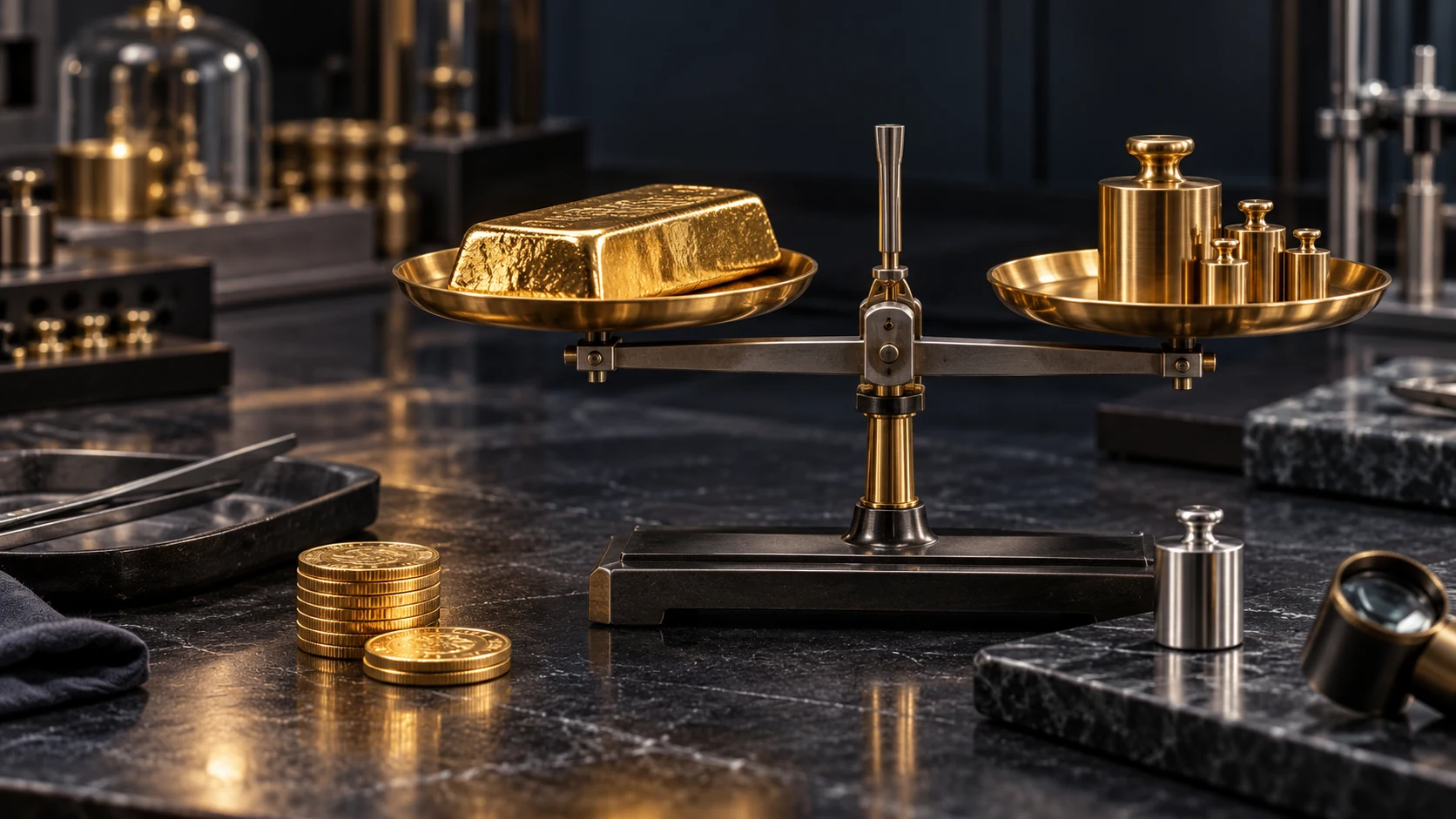
Gold prices in the United States are normally quoted per troy ounce, not the everyday ounce used for food and household goods. One troy ounce equals exactly 31.1034768 grams, while one avoirdupois ounce equals exactly 28.349523125 grams. Confusing the two can create a valuation error of nearly 10% before dealer premiums, spreads, fees, or taxes enter the calculation.
The short answer
Gold is measured in troy ounces because precious-metals markets retained a specialized historical weight system. The unit became a common standard for trading high-value metals, and modern bullion and futures markets still use it.
In practical terms:
- 1 troy ounce = 31.1034768 grams
- 1 ordinary or avoirdupois ounce = 28.349523125 grams
- 1 troy ounce = 480 grains
- 1 ordinary ounce = 437.5 grains
A troy ounce is therefore about 2.754 grams, or 9.7%, heavier than an ordinary ounce.
When a gold-price page says gold is a certain number of dollars “per ounce,” it almost always means per troy ounce. A retail listing should still state its unit clearly.
What is a troy ounce?
The troy ounce is a unit of mass used mainly for gold, silver, platinum, and other precious metals. NIST's 2026 Handbook 44 lists one troy ounce as 480 grains and approximately 31.103 grams. The Royal Mint gives the more precise metric conversion of 31.1034768 grams.
The troy system has pounds and ounces, but it is not organized like the ordinary U.S. weight system:
- A troy pound contains 12 troy ounces, or 5,760 grains.
- An avoirdupois pound contains 16 ordinary ounces, or 7,000 grains.
This produces a detail that initially sounds contradictory: a troy ounce is heavier than an ordinary ounce, but a troy pound is lighter than an ordinary pound because it contains only 12 ounces.
Gold prices use the ounce, not the troy pound. NIST notes that the troy pound remains legal in the United States but is infrequently used.
Why did precious-metals markets keep a separate ounce?
The troy system developed as a commercial weight system in medieval Europe and became associated with valuable metals. Standard units reduced ambiguity when merchants, mints, refiners, and assayers exchanged material across markets.
The precise history behind the word “troy” is often simplified in popular accounts, so it is safer not to treat a single origin story as settled fact. What is well documented is the system's long institutional use. NIST says the U.S. Mint constructed and standardized a troy pound in 1824, which the federal government then used as a unit for weight comparison. The United States later developed broader national measurement standards, but the troy ounce remained embedded in precious-metals trade.
The survival of the unit is also practical. Changing the quotation standard would require contracts, product specifications, refinery records, dealer systems, price histories, and investor conventions to be restated. A shared specialized unit is less confusing for the professional market than mixing several regional measures—provided buyers know what “ounce” means.
Is the troy ounce still an official U.S. precious-metals unit?
Yes. NIST's precious-metals guidance, drawn from Handbook 130's model method-of-sale regulation, says gold, silver, and platinum sold by weight should be expressed in either troy weight or SI units. If a seller uses SI units, the model rule calls for a conversion chart to troy units to help buyers compare prices.
State adoption and enforcement of model rules can vary, but the guidance illustrates why U.S. precious-metals commerce commonly uses troy ounces, pennyweights, grains, grams, or kilograms rather than ordinary ounces.
The futures market uses the same convention. CME Group's benchmark COMEX Gold futures contract is 100 troy ounces and is quoted in U.S. dollars and cents per troy ounce. Its Micro Gold contract represents 10 troy ounces, while the newer 1-Ounce Gold futures contract is also quoted per troy ounce.
Troy ounce versus regular ounce
The ordinary ounce in U.S. daily life is the avoirdupois ounce. It is used for most packaged goods and general weight measurements.
Here is the direct comparison:
| Unit | Grains | Grams | Common use | | --- | ---: | ---: | --- | | 1 troy ounce | 480 | 31.1034768 | Gold and other precious metals | | 1 avoirdupois ounce | 437.5 | 28.349523125 | Food and ordinary goods |
The ratio is approximately 1.09714. In other words, one troy ounce weighs about 1.097 ordinary ounces.
The reverse is also useful: one ordinary ounce is about 0.91146 troy ounce.
How to convert a gold price per ounce to a price per gram
Use this formula:
Gold price per gram = gold price per troy ounce ÷ 31.1034768
For a hypothetical spot quote of $3,000 per troy ounce:
$3,000 ÷ 31.1034768 = about $96.45 per gram
That is the theoretical metal value before adding or subtracting dealer premiums, bid-ask spreads, fabrication costs, shipping, storage, taxes, or assay deductions.
To estimate the metal value of a product containing a known fine-gold weight:
Fine-gold value = price per troy ounce × fine-gold grams ÷ 31.1034768
Suppose a piece contains 10 grams of fine gold and the hypothetical gold quote is $3,000 per troy ounce:
$3,000 × 10 ÷ 31.1034768 = about $964.52
This does not mean a dealer must buy or sell the item at $964.52. Retail products trade around metal value, not automatically at it. See our [bullion premium break-even guide](https://goldsilver.top/blog/gold-bullion-premiums-break-even-calculation) for the costs that can separate spot value from an investor's actual return.
Why a “one-ounce” Gold Eagle weighs more than one troy ounce
The phrase “one-ounce coin” may describe its fine-gold content rather than its total weight.
The U.S. Mint lists the one-ounce American Gold Eagle as 91.67% gold, 3% silver, and the balance copper. It contains one troy ounce of gold but has a gross weight of 1.0909 troy ounces, or 33.931 grams. The extra mass is alloy metal added for durability.
By contrast, the U.S. Mint lists the one-ounce American Buffalo bullion coin as 99.99% gold with a weight of one troy ounce, about 31.103 grams. Its gross weight and fine-gold weight are nearly the same because it is much purer.
This is why buyers should check both:
- gross weight: the mass of the entire coin or bar;
- fine-gold weight: the mass of pure gold after accounting for fineness.
Multiplying gross weight by the stamped denomination or assuming every gram is pure gold can produce the wrong valuation. For more on legal-tender markings, read [why a $50 Gold Eagle is worth more than its face value](https://goldsilver.top/blog/gold-eagle-face-value-vs-bullion-value).
How purity changes the calculation
Fineness expresses the share of a product that is gold. Common descriptions include:
- .9999 fine: 99.99% gold
- .999 fine: 99.9% gold
- .9167 fine: approximately 91.67% gold, commonly described as 22 karat
- .750 fine: 75% gold, or 18 karat
For a product whose fine-gold content is not already stated:
Fine-gold weight = gross weight × fineness
If a hypothetical item weighs 20 grams and is .750 fine:
20 × 0.750 = 15 grams of fine gold
At a hypothetical $3,000-per-troy-ounce quote, its theoretical gold content would be:
$3,000 × 15 ÷ 31.1034768 = about $1,446.78
Again, this excludes testing costs, dealer spreads, premiums, condition, collectibility, and taxes.
Common ounce mistakes that can cost money
Treating the kitchen ounce as a gold ounce
Using 28.3495 grams instead of 31.1035 grams overstates the per-gram value derived from a troy-ounce quote by about 9.7%.
Confusing total coin weight with fine-gold weight
Alloyed coins can weigh more than their stated gold content. Use the mint's fine-weight and composition specifications.
Ignoring fractions
A one-tenth-ounce bullion coin contains one-tenth of a troy ounce of fine metal, not one-tenth of an ordinary ounce. Fractional coins also often carry higher percentage premiums than full-ounce products.
Assuming “oz” is always sufficiently clear
Precious-metals convention points to troy ounces, but a careful invoice or product page should specify “troy oz,” “oz t,” grams, and fineness. Ask for clarification when the unit is ambiguous.
Valuing jewelry by karat and gross weight alone
Stones, clasps, solder, springs, and non-gold parts may be included in gross weight. A buyer may also deduct refining, assay, or handling costs.
A quick checklist for U.S. gold buyers
Before comparing two listings, verify:
- whether weight is in troy ounces, grams, or ordinary ounces;
- whether the stated weight is gross weight or fine-gold weight;
- the fineness or karat;
- the implied price per gram or per troy ounce of fine gold;
- dealer premium and resale spread;
- shipping, insurance, storage, payment, and tax costs;
- whether the product is bullion, collectible, jewelry, a fund share, or a futures contract.
A fund share is not itself a troy ounce of metal. Its gold exposure depends on the trust's structure and gold per share. Our guide to [redeeming gold ETF shares for physical metal](https://goldsilver.top/blog/can-you-redeem-gold-etf-for-physical-gold) explains that distinction.
Frequently asked questions
How many grams are in a troy ounce of gold?
Exactly 31.1034768 grams.
Is a troy ounce heavier than a regular ounce?
Yes. A troy ounce is about 2.754 grams heavier, or approximately 9.7% heavier, than an avoirdupois ounce.
Why is a troy pound lighter than a regular pound?
A troy pound has only 12 troy ounces, totaling 5,760 grains. An avoirdupois pound has 16 ordinary ounces, totaling 7,000 grains.
Does a one-ounce gold coin always weigh 31.1035 grams?
No. A nearly pure one-ounce coin may weigh about that much, but an alloyed coin can weigh more while still containing one troy ounce of fine gold. The one-ounce American Gold Eagle weighs 33.931 grams overall.
Is the spot gold price based on a troy ounce?
Yes, mainstream U.S. and international gold-market quotes are generally expressed per troy ounce. Physical retail products usually trade above or below theoretical spot value because of premiums and spreads.
Sources and methodology
Conversions and product specifications were verified on October 21, 2026 against primary institutional sources. Calculations use 31.1034768 grams per troy ounce and are rounded to the nearest cent where appropriate.
- [NIST 2026 Handbook 44, Appendix C: General Tables of Units of Measurement](https://www.nist.gov/document/2026-nist-handbook-44-appendix-c)
- [NIST: Precious Metals Conversion Information](https://www.nist.gov/pml/owm/metric-si/unit-conversion/precious-metals-conversion-information)
- [NIST: A Brief History of the Office of Weights and Measures](https://www.nist.gov/pml/owm/brief-history-owm)
- [The Royal Mint: What Is a Troy Ounce?](https://www.royalmint.com/faqs/bullion/what-is-a-troy-ounce/)
- [U.S. Mint: Bullion Coin Programs](https://www.usmint.gov/coins-precious-metal-coins/bullion-coin-programs/)
- [CME Group: Gold Futures Contract Specifications](https://www.cmegroup.com/markets/metals/precious/gold.contractSpecs.html)
This article is educational and does not provide personalized investment, legal, or tax advice.