Gold · Education · Gold Properties · 5 MIN READ
Why Does Pure Gold Resist Tarnish—and What Does That Mean for Buyers?
Learn why pure gold keeps its shine, why corrosion resistance is not scratch resistance, and what bullion and coin buyers should not infer from appearance.
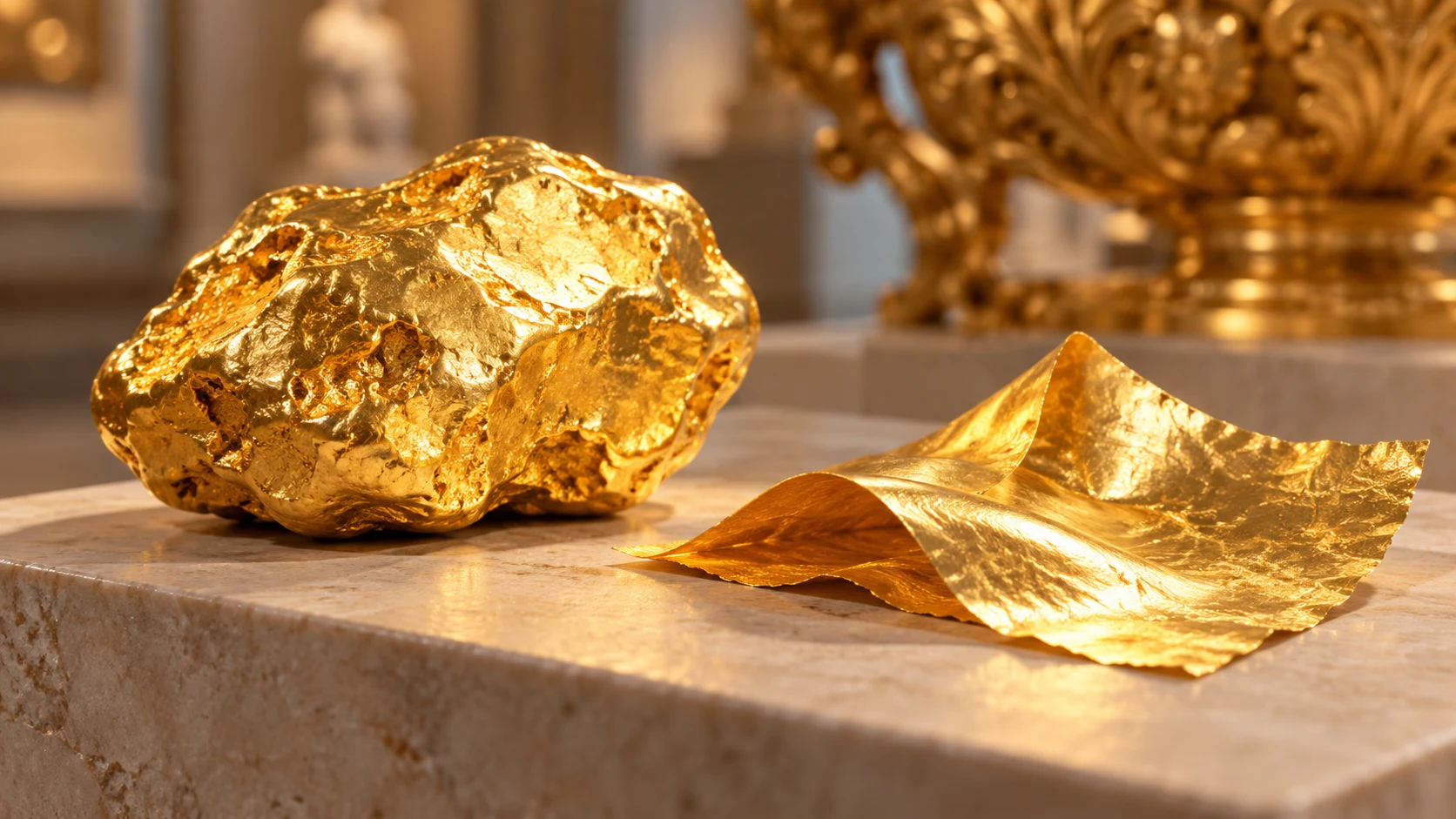
Pure gold’s lasting shine is not just a cultural symbol: it reflects a useful chemical property. Gold is comparatively unreactive, so pure gold resists the ordinary surface corrosion that changes the appearance of many other metals. But resistance to tarnish is not the same as resistance to scratching, proof of authenticity or a guarantee of investment value.
This guide answers why pure gold resists tarnish and explains what that means for US readers comparing gold bullion, gold coins and jewelry. Scientific and official coin-care sources were checked on October 19, 2026. No current metal price or promised investment return is used.
Why pure gold keeps its shine
The Royal Society of Chemistry describes gold as a yellow, soft and chemically unreactive metal. That relative lack of reactivity helps explain why it can retain a metallic appearance rather than readily developing a corrosion layer under ordinary conditions.
“Unreactive” is not an absolute. The same chemistry source notes that a specialized acid mixture can dissolve gold. That is a scientific limitation, not an invitation to perform a home test: hazardous chemical testing is unnecessary for the practical point here.
The distinction matters when reading claims such as “gold lasts forever.” A metal can resist common chemical attack and still be altered by sufficiently aggressive conditions. A responsible description is that pure gold is highly corrosion resistant, not universally indestructible.
Chemical durability is different from mechanical toughness
Gold’s softness makes a second distinction essential. A surface can resist tarnish yet still be vulnerable to physical wear. The Royal Society of Chemistry explains that pure gold is very soft and that alloys are used to improve durability. It also describes gold’s ability to be worked into thin decorative leaf.
Think of two separate questions: will the material chemically change in this environment, and will its surface survive handling without damage? A favorable answer to the first does not establish the second. “Still made of gold” and “still in its original collectible condition” are not identical claims.
Why the property has practical value
The US Geological Survey identifies corrosion resistance and electrical conductivity among the combinations of properties that make gold useful as an industrial metal. Gold is therefore more than an object selected purely for its appearance.
One useful interpretation is that a material which retains desirable surface properties can have applications where consistent performance matters. That does not mean every application requires pure gold or that industrial demand determines the whole bullion price. Material properties explain uses; market prices require additional economic evidence.
For cultural value, the same caution applies. A persistent shine and the ability to shape decorative objects help explain gold’s appeal, but chemistry alone is not a complete explanation of every society’s monetary or artistic choices. Social conventions, craftsmanship and institutions are separate parts of that story.
Why a gold-colored item is not necessarily pure gold
Do not apply the behavior of the pure element to every yellow object. Jewelry and other objects can be alloys or have only a thin gold surface layer. The chemistry source explicitly describes both alloyed jewelry and electroplated gold coatings.
The sensible inference is limited: appearance alone cannot establish the composition of the entire object. A shiny surface does not tell you its fine-gold weight, whether its interior is a different material, or whether the seller’s description is accurate. Equally, an unexpected surface mark is a reason to investigate, not enough evidence by itself to diagnose a fake.
For an important purchase, seek clear specifications, a documented seller and appropriate professional verification. Avoid destructive experiments on a valuable item simply to see whether its surface changes.
Should you polish a gold coin to restore shine?
The US Mint warns that polishing or cleaning collectible coins can reduce their value and that rubbing or brushing can scratch their surfaces. Its care guidance recommends handling coins by the edges and using suitable protective storage.
The practical lesson is to avoid treating “shinier” as automatically “more valuable.” A collectible coin’s original surface can matter. If you notice a mark on a valuable coin, preserve its documentation and consult a qualified coin professional before attempting a cosmetic fix.
Storage is still relevant even for corrosion-resistant metal. The Mint advises cool, dry storage and warns against materials such as PVC that can harm coin surfaces. Chemical resistance is not a reason to ignore packaging or careful handling.
Durable metal does not mean a guaranteed return
Consider a hypothetical gold purchase costing $2,100, including its premium. If the buyer later receives a net resale offer of $1,950, the loss is $150, or about 7.14% of the original outlay. The object can remain physically recognizable as gold throughout that period while its realizable financial value falls.
Those numbers are invented solely to illustrate arithmetic, not current quotes. The example separates material survival from investment performance. For more on purchase costs, read https://goldsilver.top/blog/gold-bullion-premiums-break-even-calculation . For a different kind of valuation distinction, see https://goldsilver.top/blog/why-us-gold-reserves-valued-42-dollars-book-value .
Frequently asked questions
Is pure gold completely immune to chemical damage?
No. It is highly unreactive under ordinary conditions, but specialized chemical conditions can affect it. Do not interpret corrosion resistance as unlimited immunity.
Does a shiny appearance prove that a bar is genuine?
No. Surface appearance alone does not establish composition, purity or fine-gold weight. Verification is a separate task.
Can a corrosion-resistant gold coin still lose value?
Yes. Physical condition, market prices and transaction costs are different issues. Tarnish resistance does not establish what a future buyer will pay.
Sources and scope
Royal Society of Chemistry, Gold: element information, properties and uses: https://periodic-table.rsc.org/element/79/Gold . Used for chemical unreactivity, softness, alloys, gold leaf and plating. This article does not adopt the page’s historical production statistics or make a current mining-supply claim.
US Geological Survey, Gold Statistics and Information: https://www.usgs.gov/centers/national-minerals-information-center/gold-statistics-and-information . Used for the connection between physical properties and industrial applications.
US Mint, Caring for Your Coin Collection: https://www.usmint.gov/learn/collecting-basics/caring-for-your-coin-collection . Used for handling, storage and cleaning cautions. Care guidance is not an authentication method.
The investment example uses (resale proceeds minus original cost) divided by original cost. No personalized investment, conservation or chemical-testing advice is provided. Gold prices can fall, and owning physical metal involves practical risks and costs.